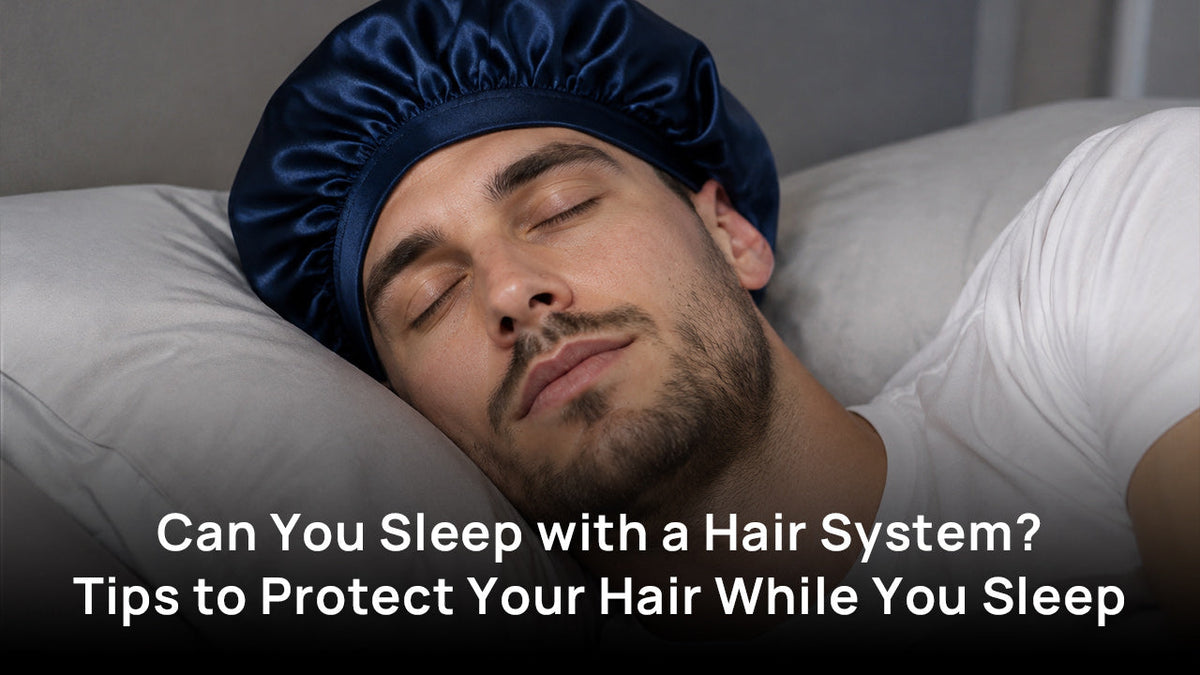
Quick Answer
Yes, you can sleep with a hair system on if your attachment is intended for overnight wear, the hair is dry, and the bond is secure. If your system is designed for daily removal, remove it before bed; if you use a suitable extended-wear attachment, follow its directions and protect the hair from friction. Lace and skin bases need different compatible attachment methods, not a universal adhesive routine.
Should I remove it every night or wear it overnight?
Choose nightly removal for a daily-removal setup, especially when taking it off fits your cleaning routine. Choose overnight wear only when your attachment directions allow it and you can keep the hair dry, detangled and securely attached.
The trade-off is convenience versus overnight friction: sleeping in your system avoids daily reattachment, but adds pillow friction and makes morning checks important. Removing it reduces overnight rubbing but requires careful removal and reattachment. Do not force a daily-removal system into extended wear because mornings are busy.
How does sleeping affect my hair system?
Reduce rubbing against your pillow to limit mechanical wear. Watch for these changes when checking the hair and attachment:
- Shedding: friction can pull on strands and their attachment points.
- Tangles: movement can twist strands together, especially in longer hair.
- Dryness and frizz: rubbing and absorbent bedding can leave hair feeling rough.
- Edge lifting: repeated contact can loosen the hairline or perimeter.
Does the base type change overnight care?
Identify your base before choosing or changing an attachment routine. LaVivid Mirage has a Full Skin Base, while Helios has a Full Lace Base; those names identify construction, not a promise of overnight comfort or hold.
Path A: Lace base
If you are not sure where to start with a lace base, start with lace-compatible tape and its matching remover, following the product directions. Do not apply liquid glue directly onto lace mesh. Lace is mesh-built, so keep the hair dry without treating ventilation as a reason to skip cleaning or edge checks.
Path B: Skin or thin skin base
If you are not sure where to start with a skin base, start with compatible liquid glue and its matching remover, following the product directions. Do not start with tape on a skin base: removal stress can tear the base. A solid poly membrane behaves differently from open lace; check for trapped dampness rather than assuming dry hair means the attachment area is dry.
When comparing men’s hair systems, use the stated base construction to identify the appropriate care path. Neither base eliminates overnight maintenance.
What should I do before bed?
Check that the hair is dry and the attachment is secure before lying down. Use this bedtime checklist:
- Use a silk or satin pillowcase to reduce drag against the hair.
- Let hair dry fully after washing; do not go to bed with damp hair.
- Gently detangle and arrange the hair so you are not lying on a bunched-up section. Keep longer hair loosely gathered rather than tightly pulled.
- Inspect the hairline and perimeter. Address lifting according to the attachment instructions; do not press down a failing bond and assume it is ready for overnight wear. Follow the manufacturer’s setting instructions after a fresh attachment.
- Keep your scalp and attachment area clean through your established removal and cleaning routine. If buildup or dampness needs attention, deal with it before sleeping in the system again.
For products that support this routine, browse hair system care products and choose according to your hair, base and attachment directions.
What should I do in the morning?
Detangle gently from the ends upward before restyling, holding the hair near the base to reduce pulling. Use a wide-tooth comb or a brush intended for hair systems rather than dragging through knots.
If needed, apply a suitable leave-in conditioner lightly to the mid-lengths and ends, keeping it away from the base and attachment perimeter. Check the edges again before styling; overnight lifting needs attention before you rely on the bond for the day. Reshape the hair gently after detangling instead of using force to flatten bedhead.

Use what you notice in the morning to adjust bedtime preparation: repeated tangling calls for more attention to detangling and hair positioning, while recurring edge lift calls for a review of the attachment routine.
How often should I remove it for maintenance?
Follow your attachment manufacturer’s removal and cleaning directions, adjusting your routine for oil, sweat, activity and bond condition. A daily-removal setup should not be treated as a multi-day bond, and a secure-looking perimeter is not a reason to ignore scheduled care in the product directions.
Repeated lifting, buildup or discomfort means the current routine needs reassessment. Stop wearing the system over persistent redness or broken skin, and seek qualified help for significant irritation; ask a hair-system consultant to review recurring attachment problems. Consult the hair system maintenance guide for the broader cleaning and care process.
Build a bedtime care routine that fits your system
Start with dry, detangled hair and a checked attachment, then use your morning inspection to refine the routine. Explore hair system care products to support the care steps your system actually needs.